

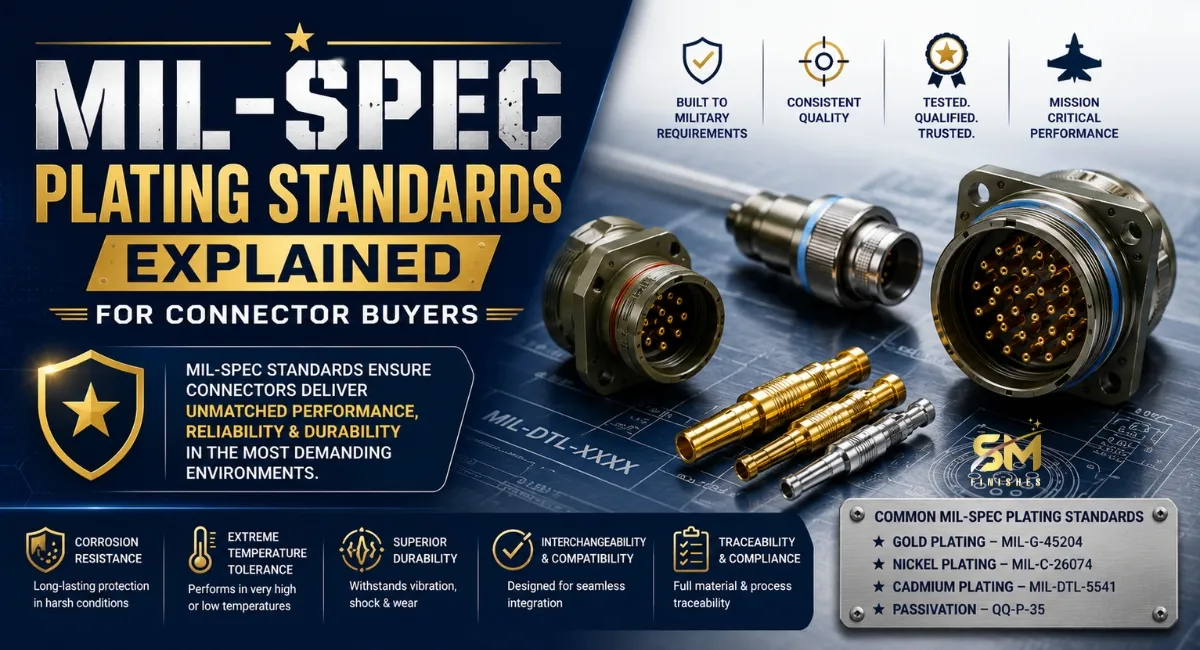
MIL-Spec Plating Standards Explained for Connector Buyers
A MIL or ASTM line on a connector drawing is a process and inspection callout. It is not the same thing as a factory “MIL-certified” sticker, and it is not a substitute for the thickness, undercoat and test method on the same print.
SM Finishes publishes the specification families we process to on About (capabilities and approvals). Buyers should copy those numbers onto the RFQ only when they match the drawing. We plate and convert to the customer spec from Machohalli, Bengaluru, under ISO 9001:2015 and AS9100:2015 — AS9100 is the aerospace quality system; the MIL/ASTM lines are the finish recipes.
Callouts we document on the About page
- Gold: ASTM B488 / MIL G 45204 (including cobalt-hardened alloy gold where specified).
- Silver: ASTM B700 / MIL QQ S365.
- Copper: ASTM B734 / MIL-C-14550.
- Electrolytic nickel: ASTM B689 / QQ-N-290.
- Tin (bright and matte): ASTM B545 / MIL T 10727.
- Electroless nickel: ASTM B733 / MIL-C-26074.
- Stainless passivation: ASTM A967 type processes. Aluminium conversion: MIL C 5541-type classes on the print.
Defence and aerospace hybrid connectors often combine several of these on one assembly: gold contacts, passivated stainless hardware, conversion-coated aluminium. See defence / AS9100 electroplating and the individual service pages. We do not claim every MIL document ever written — only the families listed for the processes we run.
What to put on the RFQ
Name the spec, class or type, thickness or film class, undercoat, and inspection method (XRF on functional areas is typical for plated contacts). Japanese and Taiwanese prints use the same families with local OEM notes — send those notes with the drawing. PPAP is available for automotive programmes (Suzuki, Maruti, Schneider, Kostal audit experience is on the case-studies page). OEM programmes include SpaceX and Israel Defence.